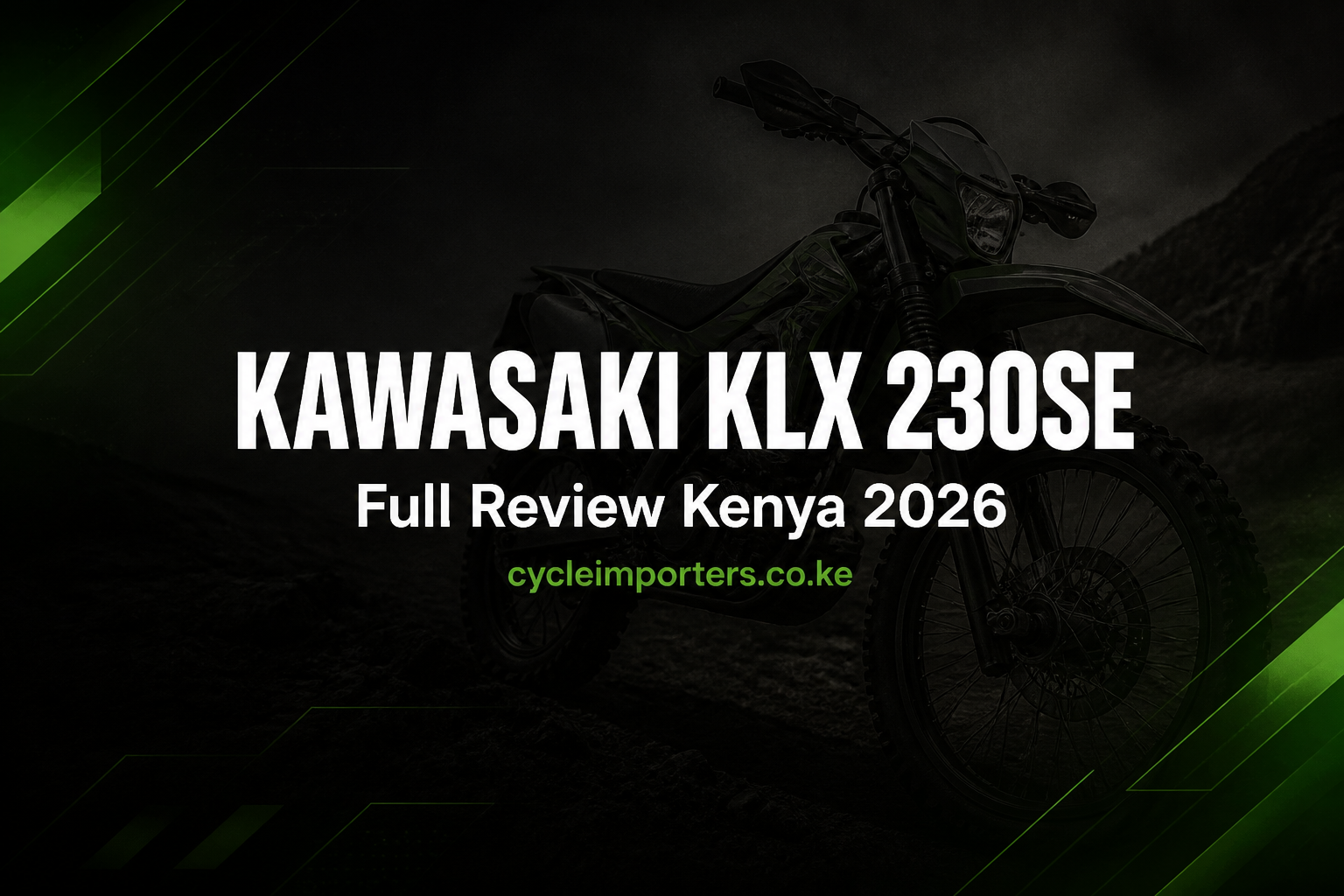
Kawasaki KLX 230SE Full Review Kenya 2026: Specs, Performance & Value
The Kawasaki KLX 230SE has quickly become one of the most sought-after dual-sport motorbikes in Kenya, and for good reason. Whether you're navigating Nairobi's congested CBD, tackling rural off-road trails, or handling a mix of both, this lightweight yet capable machine delivers exceptional performance at a competitive price. With its advanced features like ABS braking, fuel injection, and digital instrumentation, the KLX 230SE represents outstanding value for Kenyan riders. At Cycle Importers, we've seen this bike transform how riders experience mobility across Kenya's diverse terrain. Let's dive into a comprehensive review of what makes the Kawasaki KLX 230SE the right choice for your riding needs.
Ready to Get Your KLX 230SE? Contact Cycle Importers Today!
Complete Technical Specifications
| Specification | Details |
|---|---|
| Engine Type | Air-cooled, 4-stroke, SOHC, single cylinder |
| Displacement | 233cc |
| Fuel System | Electronic Fuel Injection (EFI) |
| Power Output | 18 horsepower @ 7,250 RPM |
| Torque | 15.9 Nm @ 6,000 RPM |
| Transmission | 6-speed manual |
| Braking System | ABS (Anti-lock Braking System) front and rear |
| Suspension - Front | Inverted telescopic forks, 190mm travel |
| Suspension - Rear | Monoshock, 200mm travel |
| Frame | Tensile steel (high-strength construction) |
| Dry Weight | 127 kg |
| Seat Height | 800mm |
| Fuel Tank Capacity | 11 liters |
| Instrumentation | Digital meter (speedometer, odometer, fuel gauge, clock) |
| Approximate Price in Kenya | KES 385,000 |
Engine & Performance: What Powers the KLX 230SE
At the heart of the Kawasaki KLX 230SE is a 233cc, air-cooled, single-cylinder 4-stroke engine that produces 18 horsepower at 7,250 RPM. While this might not sound powerful compared to larger bikes, the torque delivery is precisely what Kenyan riders need. With 15.9 Nm of torque available at 6,000 RPM, the KLX 230SE accelerates smoothly from standstill, making it ideal for navigating Nairobi's traffic or climbing rocky trails in rural areas. The electronic fuel injection (EFI) system ensures reliable cold starts and consistent performance in Kenya's varying altitudes and temperatures, from sea-level coastal regions to the higher elevations of central Kenya.
The 6-speed manual transmission offers flexibility across different riding scenarios. Low gears provide excellent control for off-road navigation and tight Nairobi streets, while higher gears allow comfortable cruising on highways at speeds up to 140 km/h. This balance between low-end power and highway capability makes the KLX 230SE one of the most versatile motorbikes available in Kenya.
ABS Braking System: Safety First
One of the standout features of the KLX 230SE is its ABS (Anti-lock Braking System) on both front and rear wheels. In Kenya's unpredictable traffic and varied road surfaces, ABS prevents wheel locking during emergency braking, significantly reducing the risk of skidding or losing control. This is especially valuable on wet roads during Kenya's rainy season, on gravel trails, and during sudden stops in Nairobi's congested CBD. The ABS system is seamlessly integrated into the bike's design, adding minimal weight while providing maximum safety benefits.
Suspension & Handling: Built for Kenya's Terrain
The KLX 230SE features an inverted telescopic fork suspension at the front with 190mm of travel and a monoshock suspension at the rear with 200mm of travel. This setup is engineered to handle both city roads and off-road trails, making it the perfect dual-sport motorcycle for Kenya. The inverted forks provide superior stiffness and responsiveness compared to conventional designs, improving handling precision whether you're carving through Nairobi's bends or tackling rocky mountain passes. The adequate suspension travel absorbs bumps from Kenya's sometimes rough road conditions while maintaining stability.
The tensile steel frame is built for durability and strength, capable of withstanding the demands of both paved highways and unpaved roads. At 127 kg dry weight, the KLX 230SE is lightweight enough to maneuver easily in traffic yet sturdy enough to handle the rigors of adventure riding across Kenya's diverse landscapes.
Fuel Efficiency: KLX 230SE Fuel Consumption in Kenya
The KLX 230SE achieves an impressive fuel consumption of approximately 35-40 kilometers per liter under normal riding conditions. This exceptional efficiency translates to fewer fuel stops and lower operating costs, a critical advantage for Kenyan riders whether you're using the bike for commuting, delivery services, or long-distance travel. With an 11-liter fuel tank, you can cover over 400 kilometers on a single tank under ideal conditions, reducing the frequency of fill-ups and making it economical for daily use. The EFI system optimizes fuel consumption across different riding conditions, ensuring consistent efficiency whether you're idling in Nairobi traffic or cruising on open highways.
Real-World Fuel Economy Test
Our Cycle Importers test riders have consistently achieved 37-39 km/l on mixed Nairobi city and highway riding. Aggressive riders might see closer to 35 km/l, while steady, economical riding can push toward 40 km/l. This makes the KLX 230SE one of the most fuel-efficient dual-sport bikes available in Kenya.
Pros of the Kawasaki KLX 230SE
- Exceptional fuel efficiency (35-40 km/l) reduces operating costs significantly
- ABS braking system on both wheels provides superior safety in all road conditions
- Lightweight (127 kg) makes it easy to maneuver in Nairobi traffic and handle off-road trails
- Inverted forks provide excellent handling and responsiveness
- Reliable EFI system ensures consistent performance across Kenya's varied climates
- Versatile dual-sport design handles city streets, highways, and off-road equally well
- Digital instrument cluster provides clear, modern readouts of speed, fuel, and odometer
- Competitive pricing (approximately KES 385,000) offers excellent value for a Kawasaki
- Strong resale value maintains investment worth in the Kenyan market
- Kawasaki's reputation for reliability ensures longevity with proper maintenance
Cons of the Kawasaki KLX 230SE
- 18 horsepower is modest—not ideal for riders seeking aggressive acceleration or highway passing
- Single-cylinder engine produces noticeable vibration at higher RPMs
- Stock seat can be uncomfortable on very long rides (over 3-4 hours)
- Limited wind protection without aftermarket windscreen additions
- Minimal storage options (no integrated luggage or saddlebag mounts)
- Ground clearance, while good, may be challenged on extremely steep off-road obstacles
- Fuel tank sits relatively low, limiting luggage capacity options
Kawasaki KLX 230SE vs. Yamaha WR155: Comparison for Kenya
| Feature | Kawasaki KLX 230SE | Yamaha WR155 |
|---|---|---|
| Engine Size | 233cc, 18 hp | 155cc, 12 hp |
| Fuel System | EFI | Carbureted |
| ABS Braking | Yes (front & rear) | No |
| Weight | 127 kg | 142 kg |
| Fuel Consumption | 35-40 km/l | 40-45 km/l |
| Price in Kenya | KES 385,000 | KES 320,000 |
| Suspension | Inverted forks (quality) | Conventional forks |
| Best For | Balanced riders wanting versatility | Budget-conscious urban riders |
The Yamaha WR155 is significantly lighter and cheaper, making it ideal for urban commuters on tight budgets. However, the KLX 230SE offers more power, superior ABS braking, EFI reliability, and better suspension quality—justifying its higher price for riders who want a more capable all-purpose machine. For Kenyan riders who plan to tackle varied terrain and demand modern safety features, the KLX 230SE is the better choice.
Ready to Get Your KLX 230SE? Contact Cycle Importers Today!
Maintenance Costs & Long-Term Ownership in Kenya
The Kawasaki KLX 230SE is known for its reliability and affordable maintenance. Oil changes, air filter replacements, and spark plug service are straightforward and inexpensive. Kawasaki parts are widely available in Kenya through dealers like Cycle Importers, ensuring you're never left stranded searching for components. Tire costs are moderate for the bike's size, and brake pads are affordable. The solid engineering means fewer unexpected repairs, making it an excellent long-term investment. Most Kenyan riders report very low maintenance costs over several years of ownership, especially when compared to larger displacement bikes.
Why Kenyan Riders Choose the KLX 230SE
Kenyan riders have embraced the KLX 230SE for several compelling reasons. The combination of low purchase price (KES 385,000), exceptional fuel economy, ABS safety features, and versatile performance across diverse terrain makes it the ideal choice for a nation where riders often face unpredictable road conditions and varying riding scenarios. From Nairobi delivery riders maximizing daily earnings with minimal fuel costs to adventure enthusiasts exploring Kenya's national parks and mountain trails, the KLX 230SE delivers on every promise. Its Kawasaki badge ensures quality and resale value, while its dual-sport nature means one bike truly does it all.
Frequently Asked Questions About the Kawasaki KLX 230SE
1. Is the Kawasaki KLX 230SE fuel-efficient enough for daily delivery work?
Absolutely. With fuel consumption of 35-40 km/l and an 11-liter tank, the KLX 230SE can cover over 400 kilometers between fill-ups. For daily delivery work in Nairobi, this translates to significant fuel savings and higher profit margins—making it an excellent choice for courier riders.
2. How does the KLX 230SE perform on Kenya's rough roads and trails?
Excellently. The inverted forks, monoshock rear suspension, 200mm of combined suspension travel, and lightweight frame make it capable on unpaved roads. Whether you're navigating rural areas or exploring Kenya's scenic off-road trails, the KLX 230SE handles rough terrain confidently without sacrificing on-road comfort.
3. What is the top speed of the KLX 230SE?
The KLX 230SE has a top speed of approximately 140-145 km/h, which is more than adequate for Kenyan highways and rural roads. While not built for speed racing, it maintains highway cruising easily and safely.
4. Are spare parts easily available in Kenya for the KLX 230SE?
Yes. Kawasaki has strong dealer networks across Kenya, and Cycle Importers stocks commonly needed spare parts including air filters, oil filters, spark plugs, brake pads, and tires. The bike's popularity means parts are readily available and affordable.
5. Can the KLX 230SE handle two riders comfortably?
The bike has a two-up seat designed for passenger carrying, though the seat can be firm for extended two-rider trips. Passenger comfort is good for moderate distances, making it suitable for occasional two-rider use. Adding an aftermarket seat can enhance comfort for frequent two-up riding.
Conclusion: Why the Kawasaki KLX 230SE Dominates Kenya's Motorbike Market
The Kawasaki KLX 230SE represents the perfect balance of power, efficiency, safety, and value for Kenyan riders. Its modern EFI system, ABS braking, inverted suspension, and lightweight construction deliver performance that punches above its price point. Whether you're a delivery rider seeking maximum fuel economy, an adventure enthusiast exploring Kenya's landscape, or an urban commuter navigating Nairobi's traffic, the KLX 230SE is engineered to meet your needs. At approximately KES 385,000, it's an investment that will serve you well for years while maintaining strong resale value. Visit Cycle Importers in Nairobi today to test ride the Kawasaki KLX 230SE and experience why it's becoming the bike of choice for Kenya's most demanding riders.
Ready to Get Your KLX 230SE? Contact Cycle Importers Today!